


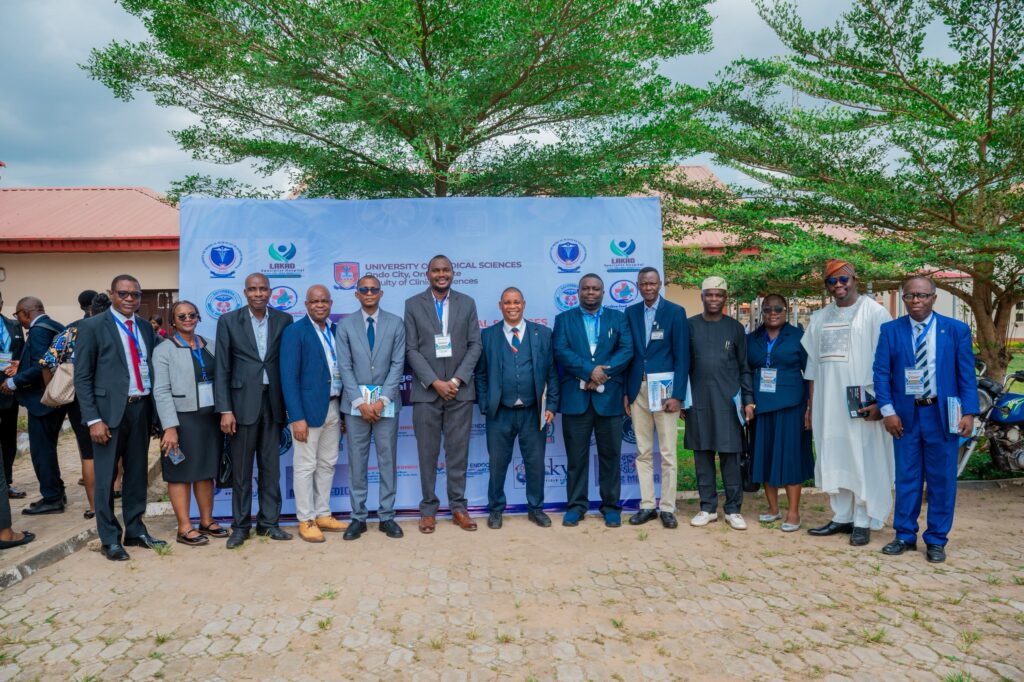
The University of Medical Sciences (UNIMED), Ondo, has reiterated the need for healthcare professionals to embrace Artificial Intelligence (AI) and digital health innovations to improve clinical practice, enhance patient safety and strengthen healthcare delivery in Nigeria.
The Vice-Chancellor of the University, Professor Ebunoluwa Adejuyigbe, who was represented by the Deputy Vice-Chancellor (Administration and Clinical Services) stated this at the 3rd Faculty of Clinical Sciences Conference held on Tuesday, November 3, 2026, with the theme, Artificial Intelligence and Digital Health: Reimagining Clinical Medicine in the Digital Era.”
Isaac Oluyi, PRO, UNIMED, in a release reports that Professor Adejuyigbe, who formally declared the conference open, described the theme as timely and significant, noting that technological innovations were fundamentally transforming healthcare delivery, particularly in disease diagnosis, treatment and patient monitoring.
She observed that Artificial Intelligence, telemedicine, digital health records and predictive analytics offered unprecedented opportunities to improve clinical decision-making, enhance patient safety, expand access to healthcare and strengthen health systems.
However, the Vice-Chancellor cautioned that the adoption of these technologies must be accompanied by careful consideration of ethical issues, data privacy, cybersecurity, equity and responsible application of AI.
According to her, technology should complement rather than replace clinical judgement, compassion and the human connection that remain central to quality healthcare.
She reaffirmed UNIMED’s commitment to remaining at the forefront of developments in medical education, research and service by equipping students and healthcare professionals with the requisite knowledge and competencies for the future of medicine.
The Vice-Chancellor encouraged participants to engage actively in the conference, exchange ideas and develop practical solutions that would advance clinical practice.
In his welcome address, the Dean of the Faculty of Clinical Sciences, Professor O. A. Adejumo, described the conference as an important platform for sharing knowledge, examining emerging technologies and exploring practical ways of improving healthcare delivery.
He stressed that Nigeria could not afford to remain on the sidelines of the global technological transformation in healthcare, urging medical professionals to understand, adopt and adapt relevant innovations to the country’s healthcare needs.
Professor Adejumo explained that the conference was designed not merely for academic presentations but also to encourage evidence-based discussions, build collaborations and generate ideas that participants could implement in their wards, clinics and classrooms.
He appreciated the Vice-Chancellor and the University Management for their support, while commending the Conference Organising Committee, led by Dr. Olufemi Ogundele, for their commitment and efforts towards the successful organisation of the conference. He also acknowledged the contributions of faculty members, students, sponsors, partners and other stakeholders.
Delivering the keynote presentation, Dr. Folajimi Adebowale, Chief Executive Officer of AEyeCARE Limited, examined the practical applications of Artificial Intelligence in modern clinical practice, highlighting its potential to address some of the challenges confronting healthcare delivery in Nigeria.
He drew attention to the country’s healthcare workforce challenges, including the declining number of practising doctors, the shortage of healthcare professionals and the migration of medical personnel, noting that AI-powered tools could support clinicians by improving efficiency and providing additional assistance in clinical decision-making.
Presenting evidence from international studies and healthcare initiatives in Africa, Dr. Adebowale highlighted the application of AI in breast cancer screening, diabetic retinopathy detection, tuberculosis screening, clinical documentation and diagnostic support.
He cited findings from a major Swedish breast cancer screening study involving 105,934 women, which recorded a 29 per cent increase in cancer detection with AI-supported screening, alongside a 44 per cent reduction in radiologists’ screen-reading workload without an increase in false-positive results.
He also highlighted a study involving 39,849 patient visits across 15 primary healthcare clinics in Nairobi, Kenya, where an AI-supported clinical decision tool was associated with reductions in errors relating to history-taking, diagnosis and treatment.
Speaking on home-grown innovations, the keynote speaker showcased Ubenwa, a Nigerian-founded technology that analyses newborns’ cries to identify possible birth asphyxia, demonstrating the potential of local innovation in addressing critical healthcare challenges.
He further presented AEyeCARE’s ASPIRE technology, which combines a portable retinal camera with an Android application to support the screening of patients for conditions such as cerebral malaria. The technology is designed to enable healthcare workers to obtain screening results within approximately one minute, including in settings with limited internet connectivity.
Dr. Adebowale urged medical practitioners and students to see Artificial Intelligence as an assistant rather than a replacement for professional expertise. He emphasised that clinical judgement, empathy and local knowledge would remain indispensable in medical practice.
He also highlighted the importance of responsible AI adoption, urging healthcare professionals to protect patients’ personal information, verify AI-generated information against trusted clinical guidelines, maintain professional accountability and use institutionally approved tools.
For medical students, he recommended using AI as a study partner for clinical reasoning exercises, simulated patient interactions, revision questions and explanations of complex medical concepts, while cautioning against allowing the technology to replace independent thinking and learning.
He further encouraged healthcare professionals to begin with small, measurable applications of AI in their respective workplaces, evaluate their impact and develop institutional guidelines for responsible use.
The keynote presentation underscored the need for Nigerian medical institutions and healthcare professionals to actively participate in shaping the country’s digital health future through research, innovation, collaboration and ethical technology adoption.
The conference also featured oral and poster presentations by faculty members and students, providing opportunities for academic engagement, knowledge exchange and professional networking.
The 3rd Faculty of Clinical Sciences Conference further reinforced UNIMED’s commitment to advancing medical education, promoting research and preparing the next generation of healthcare professionals for the emerging demands of clinical medicine in an increasingly digital world.




Discussion