


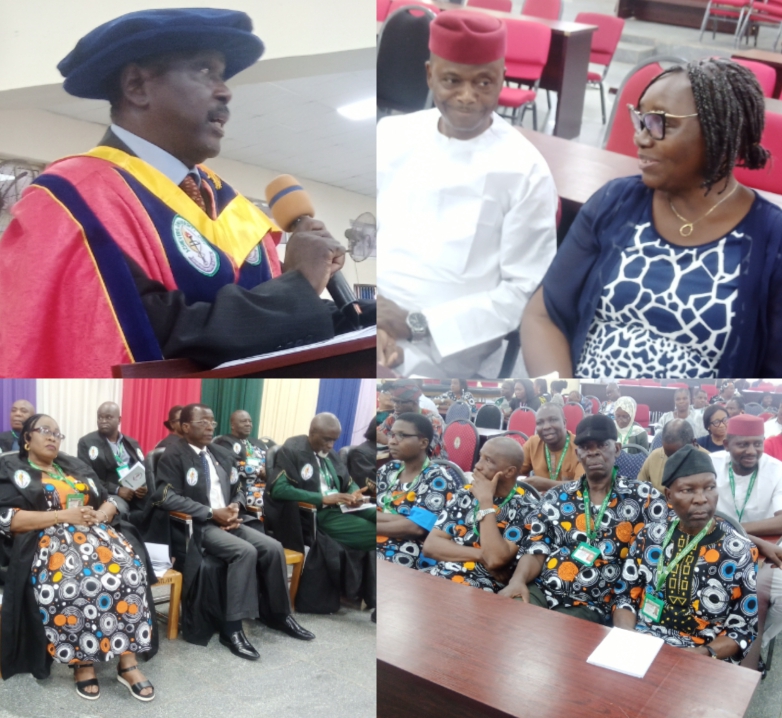
A professor of Banking and Finance at Achievers University, Owo, Prof. Adeboye Akinwunmi, has called on the Nigerian government to strengthen transparency, good governance, and digital innovation as key measures for achieving a stable and inclusive economy.
Prof. Akinwunmi made the call during the 7th inaugural lecture of the institution, on the Nigerian financial system and recapitalisation, where he examined the challenges facing the country’s banking sector and the wider economy.
According to him, sustainable economic reform requires a holistic approach that combines financial recapitalisation with accountability, technological modernisation, and policies that encourage financial inclusion.
Need for transparency and confidence
“Nigeria needs a government that will engender transparency and good governance capable of instilling confidence in the minds of the people,” Akinwunmi said.
He noted that while recapitalisation can strengthen banks, it does not automatically guarantee efficiency or ethical conduct without sound corporate governance, prudent risk management, and effective supervision.
The professor warned that overly stringent capital requirements could hinder innovation and financial inclusion, while excessively lax regulations could expose the financial system to instability.
Concerns over cash outside banking system
Akinwunmi expressed concern over the large volume of currency circulating outside the banking system, describing it as a sign of weak public trust in financial institutions and the dominance of informal economic activities.
He cited recent figures showing that out of N5.731 trillion in currency circulation in January 2026, about N5.21 trillion — representing 90.91 per cent — remained outside the banking system.
Challenges of the informal economy
The don further highlighted the overwhelming size of Nigeria’s informal sector, which he said accounts for about 92–93 per cent of total employment and contributes roughly 50–60 per cent of the country’s Gross Domestic Product.
He described the “hustle economy” as being characterised by low productivity, vulnerability, and limited access to social protection.
Digital innovation and monetary policy
Prof. Akinwunmi advocated greater use of digital payment channels and financial technology to reduce the amount of cash held outside banks, though he acknowledged that challenges such as limited digital literacy, poor internet connectivity, and financial exclusion — especially in rural areas — must be addressed.
On monetary policy, he explained that the Cash Reserve Requirement (CRR) remains a potent but blunt tool for liquidity control in developing economies.
Call for flexible CRR policy
“Rather than maintaining a rigid 50 per cent CRR, the government can make it variable by adjusting the rate quarterly or half-yearly,” he suggested.
He argued that a more flexible CRR policy would improve the effectiveness of monetary policy and better respond to changing economic conditions.
The lecture concluded with a call for balanced policymaking that promotes financial stability, competition in the banking sector, innovation, and inclusive economic growth.
Earlier, the acting Vice-Chancellor of Achievers University, Prof. Oyesoji Aremu, described the inaugural lecturer, as a thoroughbred researcher.
He said Prof. Akinwunmi has contributed immensely to the growth of the institution.

Dignitaries at the lecture include, the Pro-Chancellor and Chairman of Council of the institution, Prof. Bode Ayorinde; the VC on extended leave, Prof. Omolola Irinoye; as well as friends and family member.



Discussion