


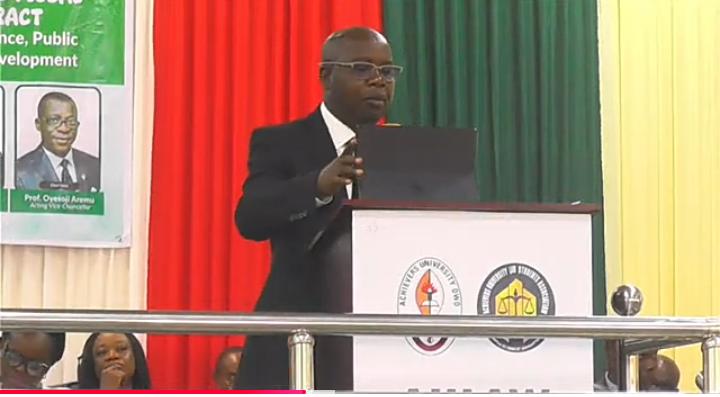
Mr. Daniel Onukun, a Legal Practitioner and Tax Expert has stated that the ultimate test of Nigeria’s new tax policy is its implementation.
Onukun, who spoke at the 6th public lecture of the Faculty of Law, Achievers University, Owo, on Monday, added that the new tax regime, if well implemented with fairness, clarity and accountability, the reforms can help Nigeria move toward a stronger fiscal social contract.
“The ultimate test of the 2025 Reform Acts will not be the beauty of their drafting or the optimism of official statements. The test will be whether implementation makes the tax system fairer, easier to comply with, more accountable, more development-oriented and more trusted,” he said.
The board secretary, Nigerian Revenue Services, however disclosed that there are several risks that could weaken the success of the reforms. According to him, some of these challenges include; public misunderstanding of the policy, administrative carryover, digital exclusion, intergovernmental resistance and that the public may not see a meaningful connection between increased revenue and improved public services.
“To guard against these risks, government and relevant tax authorities should issue clear guidance and sector-specific explanations of the new laws. They should organise periodic training for both tax officials and taxpayers, simplify forms and digital interfaces, protect taxpayer rights in day-to-day practice, publish performance information, strengthen coordination across levels of government, ensure that enforcement is risk-based and proportionate, and connect revenue mobilisation to visible development outcomes.
Read Also: Achievers University Law Faculty to Host 6th Public Lecture on Nigerian Tax Reforms June 1
“Academic institutions also have a role. Universities should not treat tax reform as a narrow professional topic. It touches law, economics, accounting, public administration, political science, technology, ethics and development studies. Students should be encouraged to see taxation as part of citizenship and nation-building, not merely as a compliance burden,” Onukun said.
He said the Nigerian Tax Acts 2025 represent a major moment in the country’s fiscal development.
“The reform consolidate substantive tax rules, standardise administration, redesign federal revenue institutions and strengthen coordination and dispute resolution mechanisms. But its deeper importance lies in what it could mean for the relationship between the State and the taxpayer.
“Citizens and businesses will be asked to comply, but government will also be expected to deliver. Tax authorities will have stronger tools, but taxpayers will expect stronger protections. Revenue may increase, but the public will ask whether development outcomes improve. This balance is the essence of fiscal citizenship,” he said.
The Chairman and Pro-Chancellor of the University, who is also a lawyer, Prof. Bode Ayorinde appreciated the lecturer for the intellectual discourse particularly as it relates to the new tax reform. He, however decried multiple taxation, adding that it has become a burden for business owners.
Earlier in his welcome address, Prof. Olaposi Olaseeni, Dean of Faculty of Law, said the public lecture will expose students to the relationship between the town and gown, which is aimed at bringing contemporary legal and socio-economic issues into constructive academic and public conversations. He said intellectual discourse such as the public lecture will contribute to legal scholarship, public policy formulation and contemporary development.



Discussion