


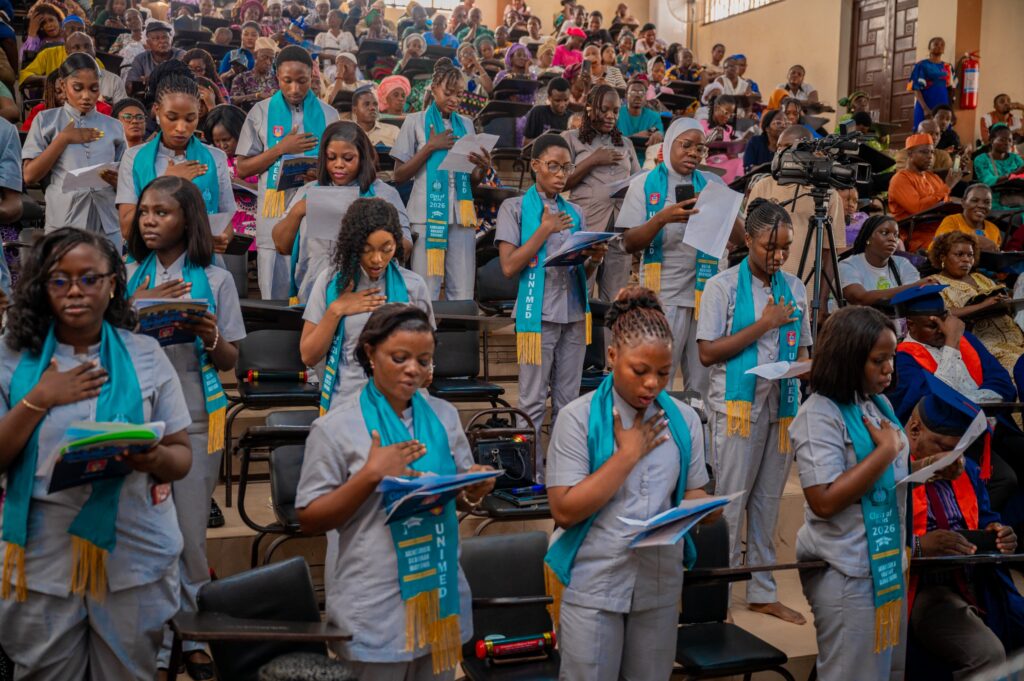
The Vice-Chancellor of the University of Medical Sciences (UNIMED), Ondo, Professor Ebunoluwa Aderonke Adejuyigbe, has charged newly inducted Community Health Science graduates of the University to embrace interdisciplinary practice, technological innovation, and effective collaboration.
Professor Adejuyigbe added that they must uphold uncompromising professional excellence, as they prepare to contribute meaningfully to Nigeria’s healthcare delivery system.
She gave the charge at the induction ceremony of Community Health Science graduates held at the University on Tuesday, November 17, 2026, where she described the profession as central to achieving effective primary healthcare and improving the health and well-being of communities.
The Vice-Chancellor noted that while tertiary hospitals remained important in managing complex medical conditions, the real foundation of public health was established at the grassroots, particularly in villages, towns and primary healthcare centres.
According to her, “Community Health Science sits at the very heart of this vision. While tertiary hospitals treat complex conditions, it is at the grassroots—in our villages, towns, and primary healthcare centres—that the battle for public health is truly won or lost. You are the vital link between specialised medical institutions and the everyday citizen.”
She explained that the University, established to bridge gaps in healthcare manpower through excellence in teaching, research and community service, considered the training of competent Community Health Scientists essential to its mandate.
Professor Adejuyigbe particularly commended the Honourable Minister of Education, Dr Maruf Tunji Alausa, for the historic approval of the internship programme for Community Health Science graduates, describing the development as a significant milestone in the advancement of the profession.
She observed that the approval would provide graduates with structured clinical exposure, supervised practical experience and a more standardised transition into professional practice.
The Vice-Chancellor also applauded the Registrar/Chief Executive Officer and the entire leadership of the Community Health Practitioners Registration Board of Nigeria (CHPRBN) for their sustained advocacy and commitment towards making the internship initiative a reality.
Addressing the inductees, Professor Adejuyigbe identified four critical pillars that would shape the future of Community Health Science: interdisciplinary practice, seamless collaboration with other healthcare professionals, technological innovation and uncompromising professional excellence.
She urged the graduates to cultivate productive working relationships with physicians, nurses, midwives, pharmacists, medical laboratory scientists, nutritionists and other healthcare professionals, stressing that no single discipline could independently address the increasingly complex health challenges confronting society.
The Vice-Chancellor further encouraged them to embrace digital health applications, telemedicine and real-time disease surveillance systems to improve access to healthcare, particularly among underserved populations.
Charging the inductees to uphold the ethics and dignity of their profession, she reminded them that their induction oath represented a solemn commitment to humanity.
“As you wear your professional badges, I charge you to uphold empathy and compassion, treating every community member with dignity. Abide strictly by the ethical regulations of the Community Health Practitioners Registration Board of Nigeria, reject quackery, and let your conduct reflect the rigorous training you received here,” she stated.
In her remarks, the Guest Lecturer, Professor Doris Atibinye Dotimi of Bayelsa Medical University, Yenagoa, who spoke on the theme, “The Future of Community Health Science,” called on the new graduates to look beyond conventional healthcare service delivery and position themselves as professionals capable of influencing public health policies, strengthening health systems and transforming communities.
Professor Dotimi observed that the changing health landscape, characterised by persistent infectious diseases, rising non-communicable diseases, emerging public health threats, environmental hazards and inequalities in access to healthcare, required a new generation of adaptable, innovative and evidence-driven Community Health practitioners.
She emphasised that the future of the profession would depend on the ability of practitioners to integrate knowledge from different disciplines, build sustainable partnerships, deploy technology responsibly and maintain high professional standards.
According to her, “Community Health is not simply where healthcare happens outside the hospital. It is how health systems understand, protect and improve population health.”
She explained that Community Health Scientists must be equipped to understand health challenges through epidemiology, community diagnosis and data analysis, develop appropriate interventions with community participation and influence the policies and partnerships that determine population health outcomes.
On the importance of collaboration, Professor Dotimi urged the graduates to move from working for communities to working with communities by actively engaging residents, traditional and religious leaders, women, young people and vulnerable groups in identifying health priorities and designing sustainable interventions.
She also highlighted the growing relevance of geographical information systems (GIS), digital health, data analytics, artificial intelligence and telehealth in strengthening primary healthcare delivery.
However, she cautioned that innovation must be ethical, affordable, accessible, locally relevant and evaluated for its impact, noting that technology should serve as a means of solving real-life health challenges rather than an end in itself.
The Guest Lecturer further identified competence, ethics, integrity, effective communication, leadership and accountability as indispensable attributes of successful Community Health practitioners.
She encouraged the inductees to explore opportunities beyond conventional primary healthcare facilities, noting that their professional expertise could be deployed in government and policy development, research and academia, industry, humanitarian organisations, development agencies and digital health innovation.
In her charge to the new professionals, Professor Dotimi outlined five commitments they must embrace: protecting the public, remaining evidence-driven, building partnerships, pursuing continuous learning and demonstrating measurable results.
She stressed that professional success should be measured not merely by qualifications or job titles but by competence, integrity and the positive impact practitioners make in the lives of the people they serve.
“Your qualification opens the door. Your competence earns confidence. Your character builds trust. Your impact defines your legacy,” she advised.
The Vice-Chancellor, in her appreciation, acknowledged the contributions of the CHPRBN leadership, the Dean and Head of Department, faculty members and clinical instructors for their commitment to training the graduates. She also commended parents and guardians for their sacrifices and unwavering support throughout the academic journey of the inductees.
She congratulated the newly inducted Community Health Scientists and urged them to remain worthy ambassadors of UNIMED, Ondo, while contributing to the transformation of community health practice in Nigeria.
The ceremony marked another significant step in the University’s commitment to producing competent healthcare professionals equipped to strengthen primary healthcare delivery and improve population health.
E-signed
Isaac Oluyi
PRO, UNIMED, Ondo
17th November, 2026




Discussion